

As I stepped onto an IMAX theater stage to present my keynote to UX Y’all, I was fairly worried I was about to end the conference on a sour note.
My core argument was that UX as a field is in an existential crisis. It’s 2026, and we’re still dealing with the same insurmountable issues we had in the early 2000s—the business doesn’t understand design, doesn’t involve us in the process early enough, doesn’t value research, and thinks we’re just here to “make it pretty.”
UX has also been getting crowded—more and more people try to break into the field, and there simply aren’t enough available roles for everyone. And, on top of those continuous problems, AI has hit UX particularly hard in the past three years.
So, suffice it to say, I stepped onto that stage prepared to be a pretty big downer. I expected people to leave the theater with a bit of sadness.
To my pleasant surprise, my talk had the opposite effect. People came up to chat with me with smiles and a bit of relief in their eyes. Some told me they appreciated my candor. One person told me they were sick of people trying to pretend things were normal and the industry was fine.
There is collective catharsis in acknowledging the difficult reality of our situation. I had no easy, step-by-step solutions to offer—they don’t exist. I had no concrete predictions about what will or won’t happen to our industry—nobody can honestly promise those right now.
But what I do have to offer are my own reflections and decisions, which come from spending over a decade in a role that required me to monitor and analyze shifts in UX and design. And from my recent personal life changes, which mirror (in micro) the broader changes we’re all grappling with (in macro).
This summer, I made the difficult decision to leave my role as senior vice president of research and content at Nielsen Norman Group (NN/G). I’m very proud of the work I did and the team I built there, but I was ready for a change. As I figure out who I am when I’m not the person I’ve been for the past decade, I see a lot of parallels in how UX is rediscovering itself in the age of AI.
The UX Greenhouse
A greenhouse is a place where plants begin to grow. It’s sheltered and protected, but the plants aren’t meant to stay there forever.
The frameworks, templates, and cheat sheets we built to train everyone flooding into the field were helpful, but over time they turned into what Sarah Gibbons and Claire Jen termed “the template trap”: a checklist of methods people run without asking whether anything meaningful changes for users or the business. Shallow design has proliferated—people claim to do UX or design, but they’re really just performing it. Stickies without substance.
The greenhouse became a glass box we were trapped in. Business and other functions didn’t fully understand design, so we were relegated to UI only and brought in too late in the design process to actually improve things.
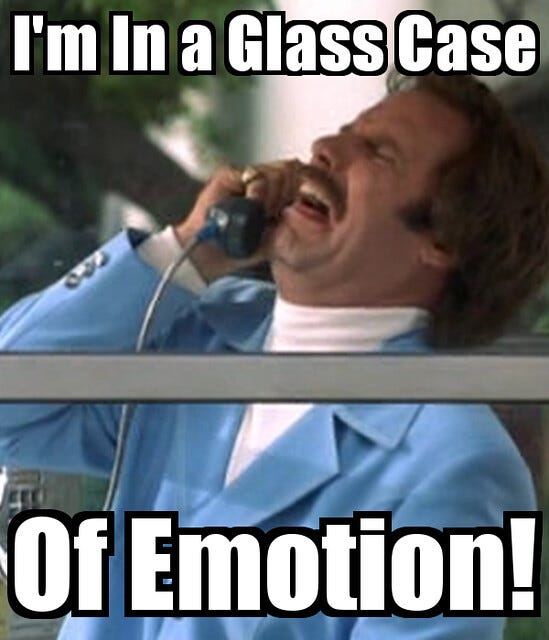
AI Will Burn Us Down or Help Us Escape. Maybe Both.
Then AI arrived. It was like someone lit a match and threw it into our greenhouse.
We’re dealing with AI disruption on multiple levels:
It’s changing our users’ behaviors and expectations.
About half of U.S. adults now use AI chatbots, and a similar share of workers use it on the job.We’re designing for users and their agents, and sometimes for people who never see our interfaces at all, because their agents do the interacting.
Bot traffic has overtaken human traffic on the web.We’re expected to figure out how to use AI in our own work (a full-time job of its own, and then some) and to know how to build AI features and products.
AI skills now show up in 37% of PM job postings and 23% of design postings.Development is moving even faster, so it’s harder than ever to fit research and design into the process.
AI lets teams build faster than UX can evaluate.
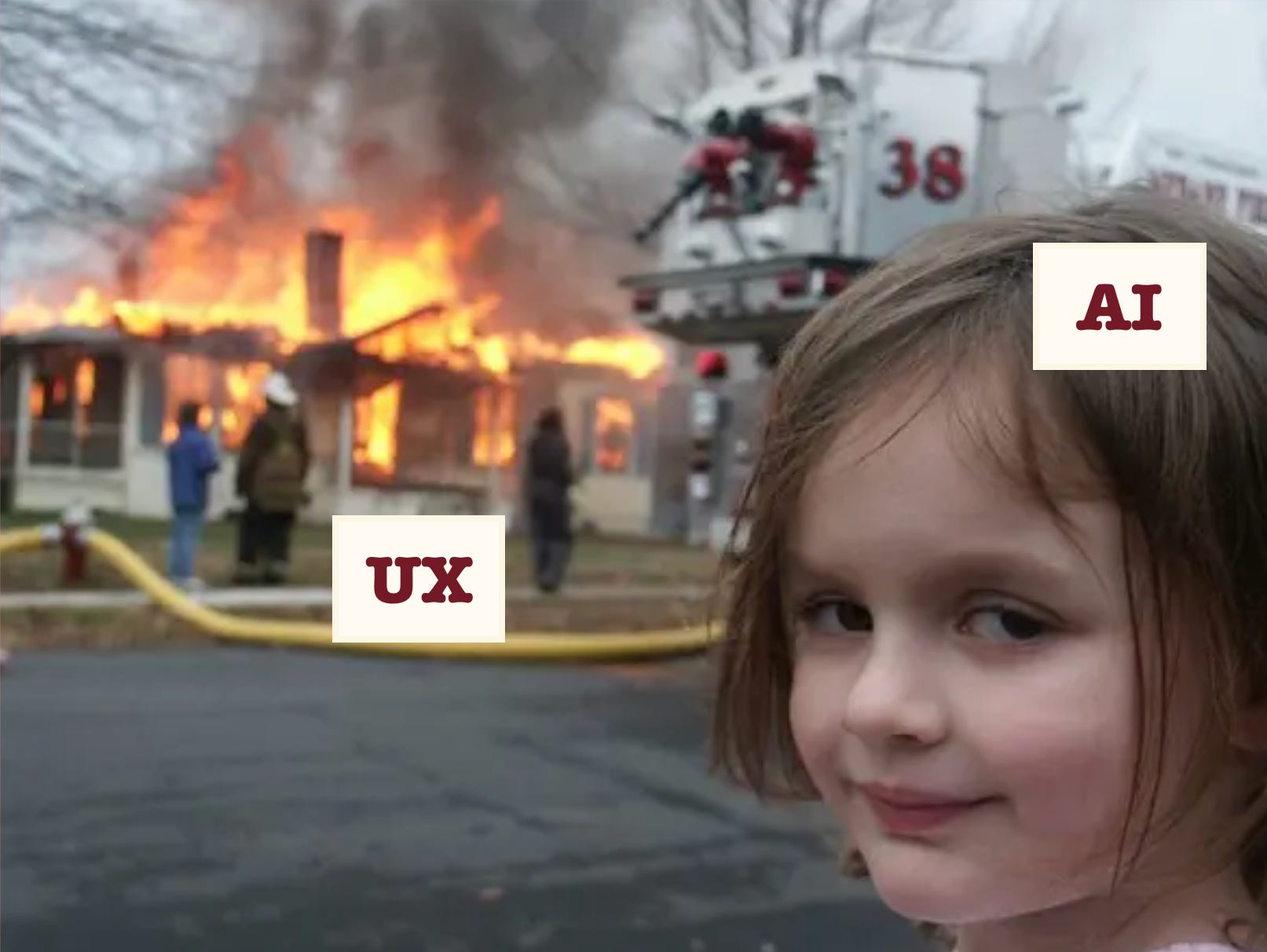
But disruption also creates opportunity, and in many ways, AI is our chance to break out of the greenhouse. And also, it’s going to force us to.
AI can now spit out a decent-looking UI with minimal input. Look closer and the output is boring and repetitive, full of AI writing tells, logical missteps, unnecessary explanatory text, and accessibility failures. That’s shallow design, and anyone who is just putting components on a screen without much thought is already extremely replaceable.
(And that’s the output when you’re just using a simple prompt with minimal steering. With careful input, strong product sense, and an iterative approach, AI tools like Claude Design can produce UIs that are downright solid.)
If people think all we do is make things pretty, we won’t have jobs for very long. They don’t need us to make products or services pretty anymore. They need us to make them:
Make sense to human beings in real life
Stand out from the growing tsunami of AI slop
Be actually useful in the systems they exist in
We’ve known for decades that a beautiful product that doesn’t solve a real user need won’t get used, and that’s still true.
Right now, the business especially needs us to make AI products trustworthy. Notice I’m not saying “make them trust it.” Trust has to be earned, not tricked.
Meta’s Muse is a complicated example, given Meta’s track record on user privacy and data. (Its cutesy mascot also looks like a Labubu, which I find terrifying.) But Muse is taking off, because it just works. People don’t have to watch a pile of YouTube videos to learn what a skill or a connector is. It shows what a difference any thought put into experience design can make.
Most AI products still fall short here. These are UX and systems design problems, and they’re holding back AI adoption.
The world needs UX right now, badly. It just doesn’t know it, and maybe it doesn’t need to. People are talking a lot about “product sense” lately, which is a new phrase for what we do. If calling myself an expert in product sense gets me hired into a role where I can achieve the goals and principles of UX, I’m OK with that.
Escape the Greenhouse!
So how do we break out? Here’s how I’m approaching it myself, in three (very horticultural) ways.
Prune
Pruning means cutting away what doesn’t work for us anymore… or what never worked well.
Of course, I’m referencing the overreliance on templates and shallow, performative design here. But I also know that we haven’t always been the easiest people to work with.
Some of our conflict with the business and with other roles isn’t our fault. But we can only change what we can control. And—I include myself here—we have sometimes been the problem.
I’ve met tens of thousands of UX professionals over the years. These attitudes don’t represent all of us, of course, but I have certainly seen and heard some concerning things:
Disdain for the business: “That’s not my job.” We all need to care where our paycheck comes from, and business success and impact are part of what the market wants from us.
Jargon: complaining that people don’t understand research, then proposing another jargon term in the same breath. I once heard an otherwise excellent speaker suggest we rename users “creators.” I like the impulse, but if we talk like that, people won’t understand what we’re saying.
Lane-keeping: “PMs do this, and UX does that. You stay in your lane.” As roles become hybrid, that isn’t an option anymore.
Hostility toward product: we see PMs as too metric-focused and too business-focused. We need to learn some of that from them, and they need to learn our approaches from us.
As we let go of the past, I’d love to leave these attitudes behind, too.
Feed
Feeding means fertilizing the rich soil that UX grew out of. UX may look very different soon, and it may not be called UX, but our core philosophies can come with us into whatever role is next:
Design for humans.
See the whole system.
Understand people.
Serve both users and the business.
Be curious and experiment.
Those principles are what AI-generated design is missing. AI design sucks if you’re not guiding it, but the more context we give it and the more we iterate, the better it gets. UX is uniquely positioned to spot what’s wrong and fix it.
The skills that got us here are highly relevant right now: understanding complex dynamics between people and technology, grounding strategic decisions in that understanding, coordinating design choices across multidisciplinary teams, designing constraints that make technology safe and reliable, and helping people make sense of context and information.
Graft
Grafting connects two plants so they grow stronger together. To really break out of the greenhouse, we’re going to have to become something new.
There are plenty of new hybrid titles floating around right now:
Context architect
Conversation designer
Customer insights analyst
Product designer
Design engineer
Agentic workflow designer
Model designer
Service designer
Product manager
UX engineer
Forward-deployed designer
Experience architect
AI product designer
Forward-deployed engineer
Systems designer
Product builder
I can’t tell you which of these titles will stick (one, some, or none of them could), but the roles will be hybrid, blurry, and AI-focused, and what we call ourselves will matter less and less.
Grief and Acceptance
It’s OK to grieve what UX used to be, to feel insecure and unstable, and to hate that feeling. But we won’t move forward unless we embrace the ambiguity. If you look at UX’s history, we’ve always been weird, ambiguous, undefined, and messy. If we hold on to what makes UX work, and not the labels, job titles, or toolkits, that will guide us through this next phase.
So here’s my advice, for the field and for myself:
Let go of the past.
Hold on to your philosophy.
Embrace the change.
Lean on your community.
The one thing I really don’t want to lose is the community we’ve built. Whatever this becomes, I hope we keep supporting each other.
References
The Template Trap: How Template Culture Is Dumbing Down UX. Sarah Gibbons and Claire Jen, NN/G, May 30, 2025.
Americans and AI 2026: Chatbots, Smart Devices and Views on Impact. Jeffrey Gottfried and colleagues, Pew Research Center, June 17, 2026.
Rising AI Adoption Spurs Workforce Changes. Andy Kemp, Gallup, April 12, 2026.
Bot web traffic has overtaken human web traffic, data shows. Samantha Elkins, NBC News, June 4, 2026.
The Most In-Demand Skills of 2026. Qarera, 2026.
The Custodial Era of UX: Cleaning Up After AI. Anna Kaley and Raluca Budiu, NN/G, Aug. 28, 2026.
Meta’s Muse is outpacing ChatGPT’s early mobile launch. Sarah Perez, TechCrunch, Sept. 21, 2026.
Further Reading
The Slow But Inevitable Demise of UX Design. Andy Budd, April 4, 2022.
The State of UX in 2024: Enter Late-Stage UX. Fabricio Teixeira and Caio Braga, UX Collective, December 2023.
The UX Reckoning: Prepare for 2025 and Beyond. Kate Moran, Sarah Gibbons, and the experts at NN/G, Jan. 10, 2025.
Why Is the UX Job Market Such a Mess Right Now? Jared M. Spool, Center Centre, Jan. 14, 2025.
The State of UX in 2025. Fabricio Teixeira and Caio Braga, UX Trends, 2025.
State of UX 2026: Design Deeper to Differentiate. Kate Moran, Raluca Budiu, Sarah Gibbons, and the experts at NN/G, NN/G, Jan. 16, 2026.
Design Changing from Artifact-Production to Intent-Shaping. Jakob Nielsen, UX Tigers, May 21, 2026.
What struck me is that your "feed" list is the part AI can't supply. It can produce a screen, but can't see the system the screen lives in, or who gets quietly affected downstream. Those who learned to read that from the inside are carrying more than a craft, and I think that's what you're asking us to hold onto. Thank you for saying the hard part out loud.
Thank you for this. I did notice the unrest and unhappiness in the UX community and I decided to write my perspective, as an engineering leader who appreciates and believes in design and ux. If curious: https://danaaonofriesei.substack.com/p/designers-are-the-least-happy-in?r=1wmkip&utm_medium=ios